THE HOLLOW TOWERS
The Towers Refuse a Common Story
They stand far apart, often within sight of routes older than the settlements around them. Their proportions resemble one another. Their stone does not always. Their interiors are mostly empty. Every generation that studied the Hollow Towers found enough similarity to propose a theory and enough contradiction to ruin it.
The towers agree in proportion more often than they agree in material, age or orientation.
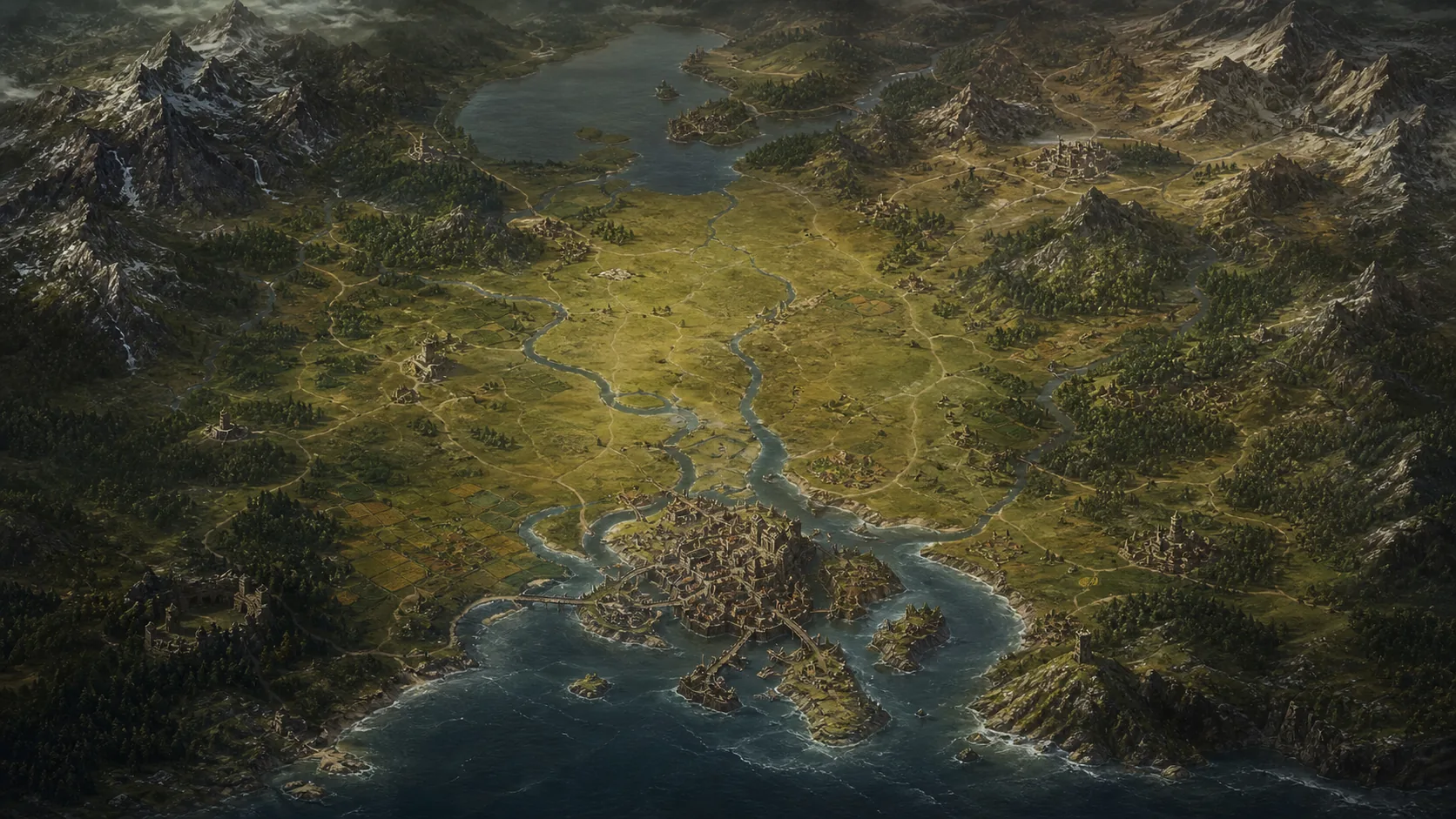
The world keeps moving
Every settlement, expedition, market shift, and regional power leaves a visible mark on the realm.
WHAT CAN BE OBSERVED
Similar silhouettes. Different histories.
Some towers rise from exposed ridges. Others are half-buried by later ground. A few were incorporated into settlements and reused as storehouses, watch posts or shrines. Those later uses are well documented. Their original purpose is not.
The name Hollow Towers is relatively recent. Earlier records call individual structures by local names and rarely treat them as a single group.
That changed when cartographers began comparing measurements. Repeated ratios appeared in doorways, stairwells and wall thicknesses. The pattern was convincing enough to suggest shared knowledge, but not enough to prove a single builder.
Several towers contain sealed recesses, collapsed lower chambers or masonry that does not match later repairs. Reports of what was found inside are inconsistent. Most finds were mundane: broken tools, animal remains, soot, storage jars and the debris of centuries of reuse.
The more dramatic stories tend to come from copies made long after the supposed discovery.
SURVEY 12 · NORTH RIDGE TOWER
The measurements matched. The doorway did not.
A comparative survey lists three towers whose wall thickness, inner diameter and stair pitch fall within nearly identical ratios. The North Ridge Tower should have completed the set. Instead, its main doorway faces away from the road and is narrower than the pattern predicts.
Surveyor's note: Do not rotate the plan to make it agree with the southern towers. Entrance faces west. Checked twice.
Second hand: Foundation may predate upper courses.
Margin correction: Or the pattern is ours, not theirs.
The final note is the shortest and the most frequently omitted in later copies.
THE DANGEROUS THEORY
A pattern is not the same thing as a message.
Later scholars repeatedly connected tower locations into lines, circles and routes. Some diagrams are elegant. None survive contact with every known tower. The structures may reflect shared techniques, repeated needs, copied designs or something more deliberate. The evidence refuses to choose for us.
Builders
Unknown
No surviving inscription reliably identifies a common builder.
Purpose
Disputed
Watchtower, marker, storehouse and ceremonial theories all have problems.
Pattern
Incomplete
The towers resemble a system more strongly than the evidence can confirm.
ROUTES
↗The Old Roads
Several surviving road fragments pass unusually close to known towers, though not consistently enough to explain them.
Follow the roadsRELICS
↗Things the World Kept
Objects recovered from reused towers reveal far more about later occupants than original builders.
Examine the relicsMAPS
↗The Cartographers' Fragments
Some of the most ambitious tower theories survive only as corrected and disputed maps.
Read the fragmentsThe towers are real. The pattern remains negotiable.
Continue through the objects, maps and roads from which generations tried to build a single explanation.