THINGS THE WORLD KEPT
Objects Outlive Explanations
Veyrlands is full of ordinary things that became mysterious only because the people who understood them are gone. A stamped weight becomes a relic when the market that used it disappears. A sealed box becomes a legend when no surviving record says what belonged inside.
Most surviving objects are clues to lost routines, not proof of lost wonders.
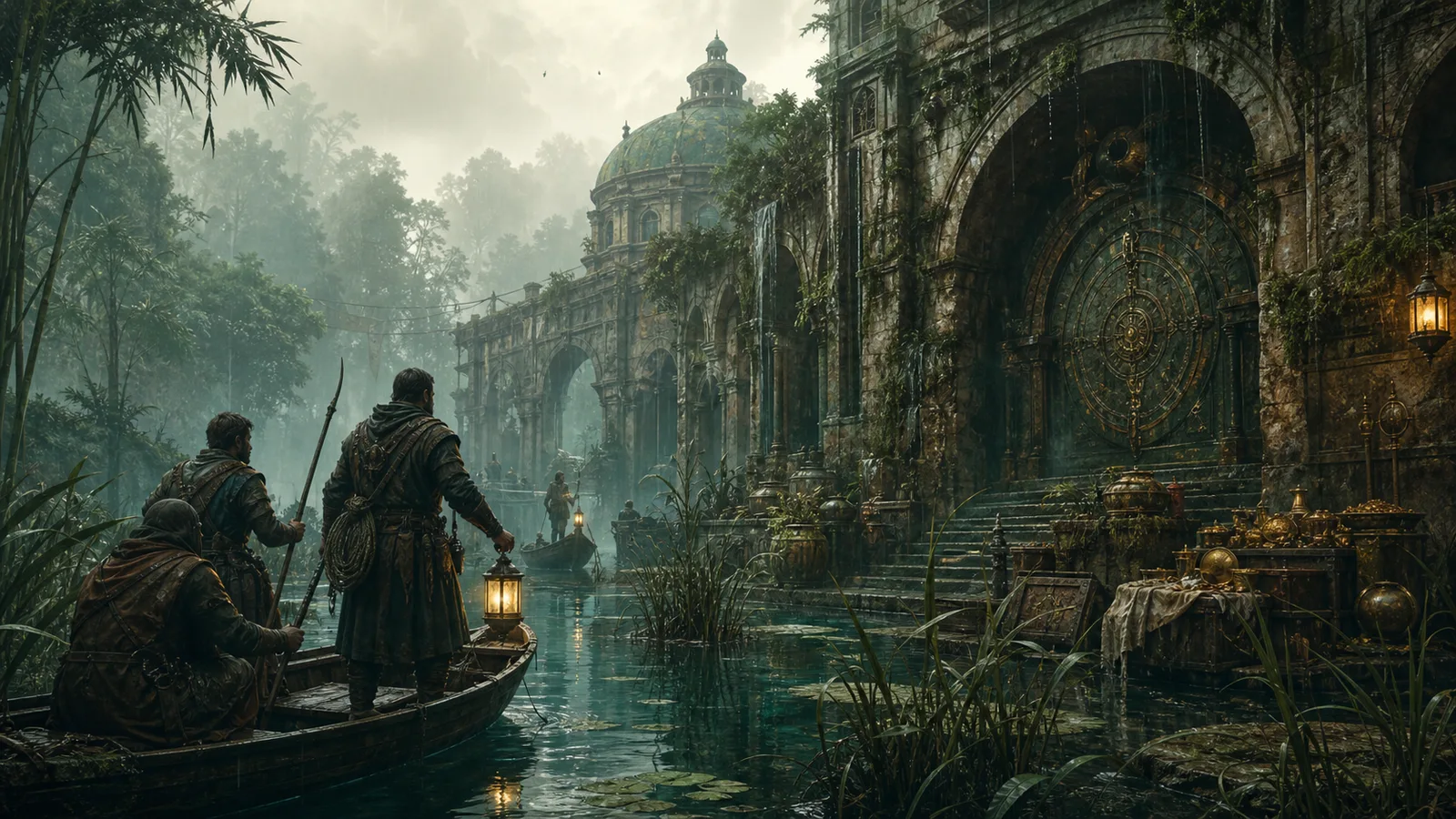
The world keeps moving
Every settlement, expedition, market shift, and regional power leaves a visible mark on the realm.
THE ARCHIVISTS' PROBLEM
Survival makes ordinary things look significant
Most recovered objects were never ceremonial, magical or unique. They were weights, tools, containers, fittings, tally pieces and trade goods. Their mystery comes from missing context, not necessarily from extraordinary purpose.
One bronze token appears in collections across three regions. Early antiquarians treated it as proof of a shared authority. Later finds complicated that theory: the markings vary, the weights are inconsistent, and several examples show obvious signs of local recasting.
A set of narrow iron keys caused similar excitement until one was found beside a surviving warehouse mechanism. The keys were unusual only because the locks they belonged to had almost entirely disappeared.
The lesson appears repeatedly in the old catalogues. When an object survives alone, people invent the missing system around it.
Some objects remain harder to place. A few materials do not match the workshops nearest to where they were found. Some sealed containers were carried long distances without being opened. Several items appear in inventories under names that have no known translation. Those are the pieces archivists label carefully and explain reluctantly.
CATALOGUE ENTRY · 88-B
A sealed box famous mostly for remaining sealed.
The object appears in three inventories spanning more than a century. Each records a small iron-bound wooden case, too heavy for its size, with no visible lock and no agreed provenance. The later descriptions are more dramatic than the earliest one.
Earliest catalogue: Box, dark wood, iron straps. Contents unknown. Received with river goods.
Later copy: Sealed reliquary from the eastern ruins. Not to be opened.
Archivist's correction: No source for “reliquary.” No source for “eastern.” The instruction not to open appears only after the box was already damaged.
Nothing in the record proves the box was important. The story around it became important because the object survived long enough for certainty to accumulate around an absence.
A GOOD RULE
Record what is known. Preserve what is not.
The best surviving catalogues distinguish material, location and condition from interpretation. That discipline matters in a world where a convincing story can spread faster than evidence. An object can acquire new meaning without requiring us to invent an old one.
Object
Certain
Material, dimensions and condition can often be recorded.
Context
Partial
Where an object was found does not always explain where it came from.
Meaning
Uncertain
Purpose is often the least reliable part of the record.
RUINS
↗The Hollow Towers
Reused towers accumulated centuries of objects that reveal later occupants more clearly than original builders.
Read about the towersMAPS
↗The Cartographers' Fragments
Old inventories preserve place names that disappeared from maps — and sometimes names that never appear anywhere else.
Read the fragmentsHISTORY
↗The World Chronicle
Objects created by future civilizations may eventually become the evidence from which later generations reconstruct their history.
Explore the ChronicleThe world kept the evidence. It did not keep the answers.
Explore the broader lore, where roads, maps, towers and ordinary objects contradict one another in useful ways.